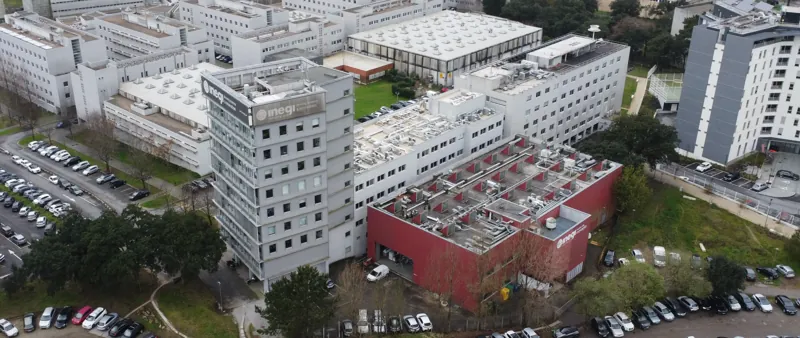
INEGI is a private, non-profit R&D institute that works with industry, linked to FEUP, the Faculty of Engineering of the University of Porto.
I work in its Advanced Monitoring and Structural Integrity unit as an R&D engineer.
Besides the technical work, I have contributed to the technical annexes of national funding proposals.
AneurysmTool
FCT-funded research project · with Hospital de Santa Marta and NOVA, Lisbon
Doctors decide when to operate on an ascending aortic aneurysm mostly by its diameter, which often fails to predict rupture.
The project set out to expand what we know about ascending thoracic aortic aneurysm tissue, and needed a way to test the actual tissue right after surgery:
inflate the removed aneurysm to blood pressure and measure how its whole surface deforms. It had to work inside a hospital, as close to the operating room as possible.
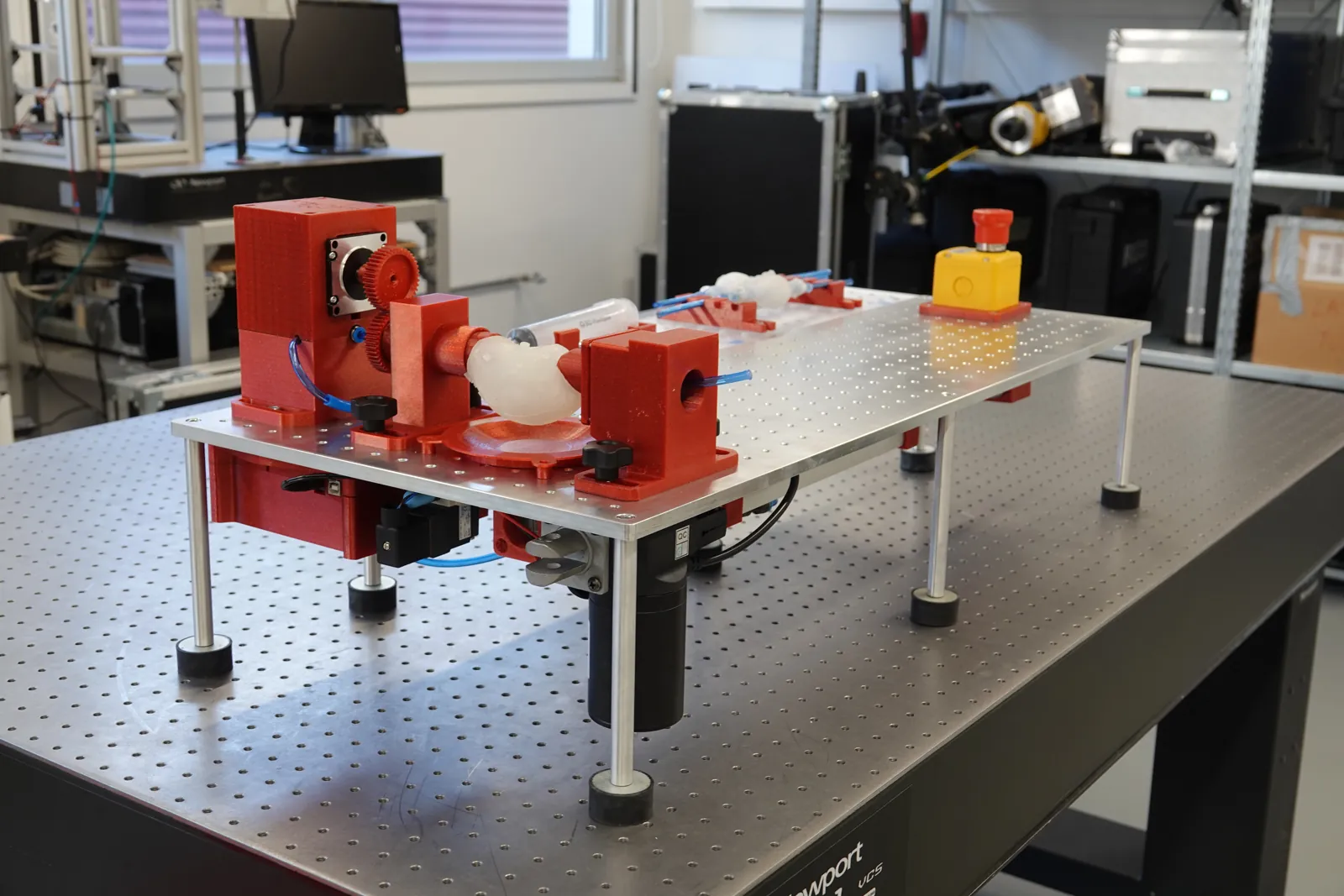
The final rig, ready for the hospital. Select a number to see what each part does.
Aorta silicone phantom. A test aorta cast from a real patient's CT scan, used to validate the rig before testing tissue.
Pressurisation system. A linear actuator driving a pneumatic cylinder, with a PID controller that holds the pressure at 80 mmHg and then 120 mmHg, diastolic and systolic.
Pneumatic valves. Give quasi-continuous pressurisation, so the pressure holds steady while images are taken.
Stepper motor and gears. Rotate the specimen in 45° steps so the cameras see the full 360° of the aorta.
Vacuum syringe. Pulls a vacuum on the balloon so it shrinks and the specimen can be slid over it.
Spare silicone balloon. The balloon is very thin so it barely affects the measurement, which means it sometimes ruptures. A spare is always at hand.
Fluid drip tray. Real tissue is wet; the tray keeps the hospital bench clean.
Emergency stop. Immediate stop and rapid depressurisation.
My part: designed and built the rig, made the silicone parts, set up the 3D digital image correlation and helped on the finite-element simulation.
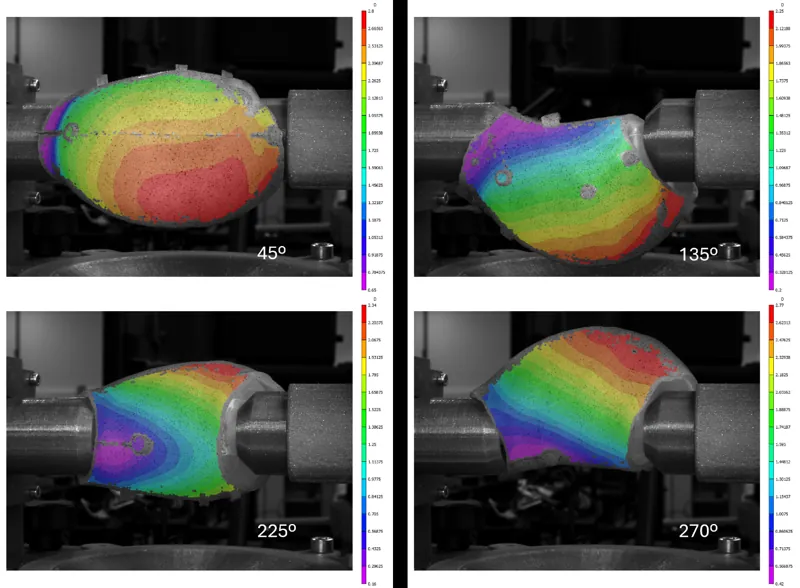
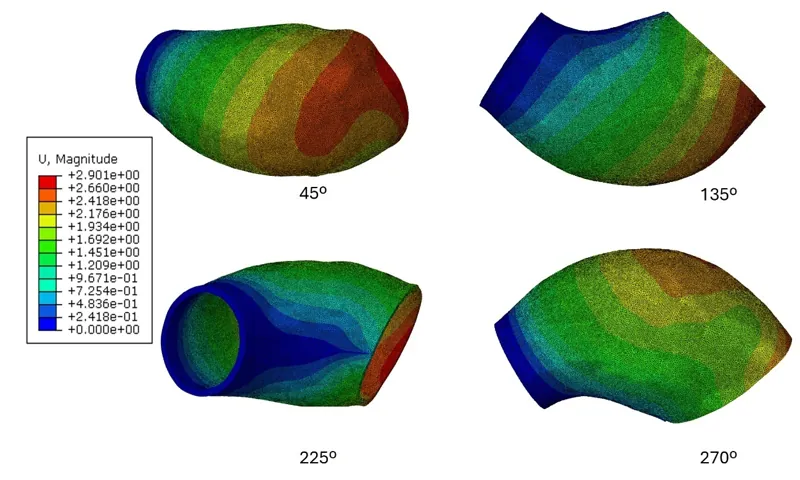
Validation against simulation · maximum displacement
Measured, 3D-DIC
2.80 mm
Simulated, FE model
2.901 mm
Δ 1.04 %
Silicone phantom inflated from 80 to 120 mmHg.Measured: 3D-DIC displacement, four of the eight angles.Simulated: finite-element model, same four angles.
Offshore wind structures are expensive to inspect and hard to reach. Inside Marewind I had the opportunity to work on two ends of the problem:
inspecting turbine blades from drones, and monitoring a structure sitting on the seabed.
Two drones in flight at a wind farm in northern Portugal. Rope-access technicians apply the speckle pattern to the blade.
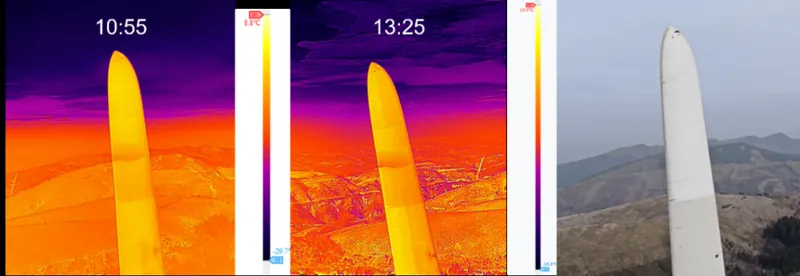
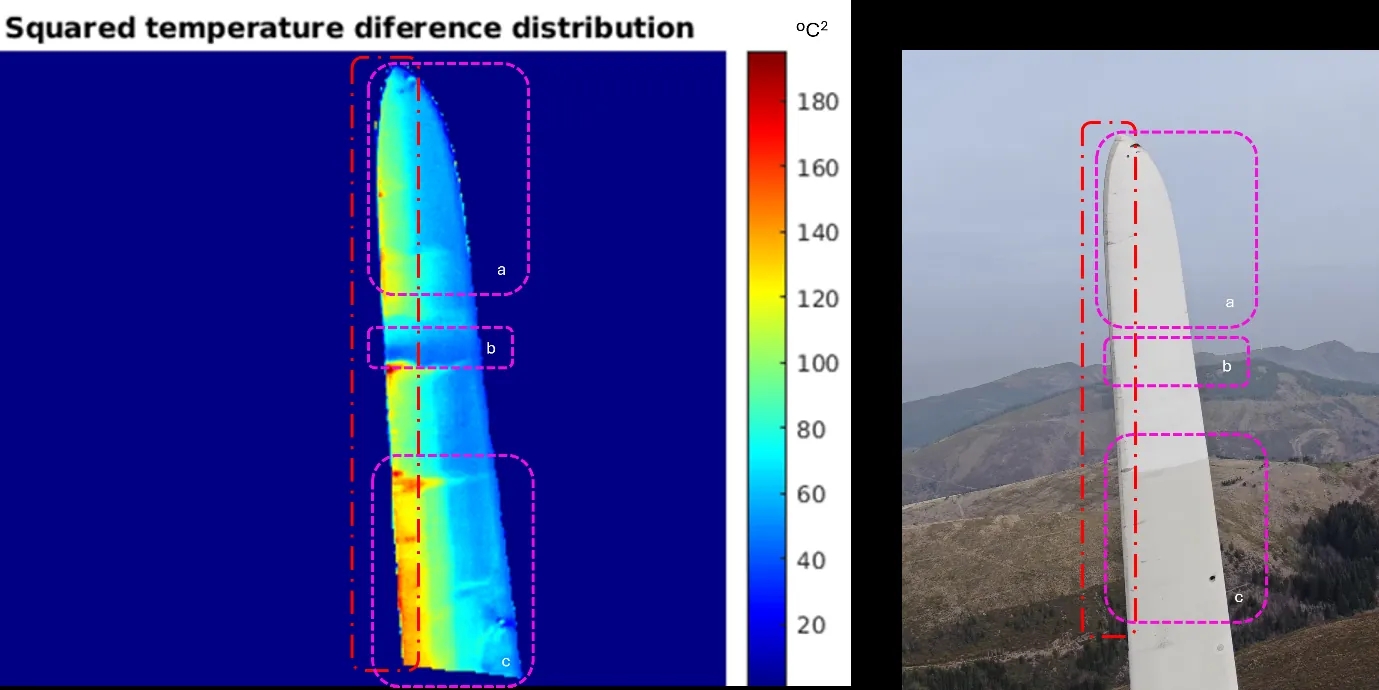
Thermal images of the same blade in the morning and at noon, next to the visible image.Where the blade heats unevenly, compared with the visible image.Presenting the work at ECF24, Zagreb.
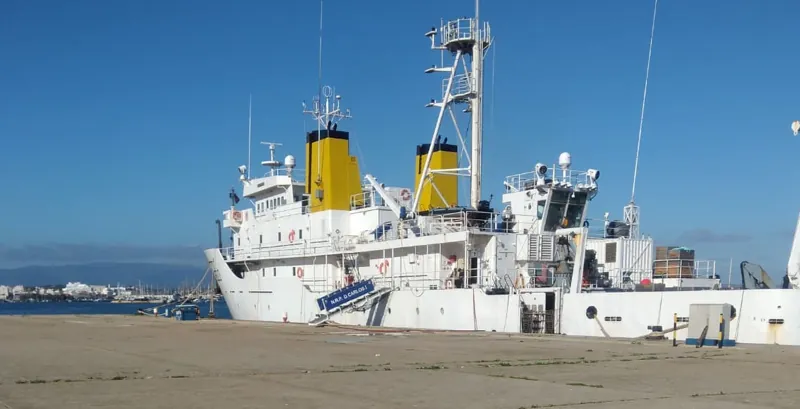
NRP D. Carlos I in Portimão, before taking the structure to sea.
The electronics, firmware and assembly I worked on.
Mooring and recovery of the gravity-based structure. Video published by INEGI.
Blades · inspection from the air
Measuring a moving blade from two drones
Stereo image correlation needs two cameras that capture at the same instant. In the lab they usually share a trigger cable; with each camera on its own drone, we needed another way to keep them in step.
Built the camera payload for the DJI Matrice 300: an industrial Basler camera and a Raspberry Pi running the DJI SDK, with the camera controlled from the remote.
Synchronised the two cameras using the GPS pulse-per-second signal.
Flew both drones during the campaign, with the blade stopped and then turning freely in the wind.
The structure-from-motion technique and the data processing were developed by colleagues.
Blades · thermography
Looking for hidden damage with a thermal camera
Inspecting a blade normally means stopping the turbine and sending people up. We tested a drone-based alternative: thermal images of the blade taken when it is cold and again after the sun warms it, so defects under the surface show up as differences in heat flow.
Flew the drone for the field tests, a DJI Matrice 300 RTK with an H20T thermal camera, at a wind farm in northern Portugal.
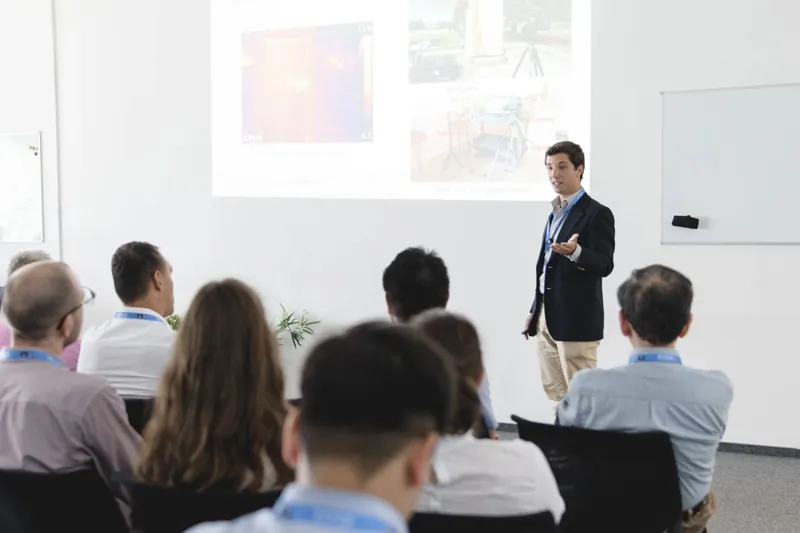
Wrote and presented the paper at the European Conference on Fracture 2024, where I also chaired my session.
A gravity-based structure, a 500 kg instrumented lander, was taken to sea on the Portuguese Navy hydrographic ship NRP D. Carlos I in December 2023. It stayed 30 m underwater off Sines for six months.
Subsea · the data logger
A custom data logger for the strain sensors
The structure carried fibre-optic and electrical strain sensors that needed a battery-powered logger able to run unattended underwater.
Designed the PCB, programmed the microcontroller and soldered and assembled the system. The sealed housing was bought in.
The system took on water during the deployment and did not return valid data.
Subsea · machine learning
Predicting strain from the state of the sea
If you can predict how much a submerged structure strains from wave height, period and direction, you can estimate its damage from sea forecasts alone.
Developed the machine-learning models (Random Forest and neural networks, tuned with Optuna) that predict strain at points on the structure from the sea state.
Trained on 81,724 sea states; mean R² of 0.96 across the 15 outputs.
The training dataset, built from Morison equations and finite-element models, was produced by a colleague. Experimental validation is still open.
Nationally funded · with the Portuguese Navy and the Instituto Hidrográfico
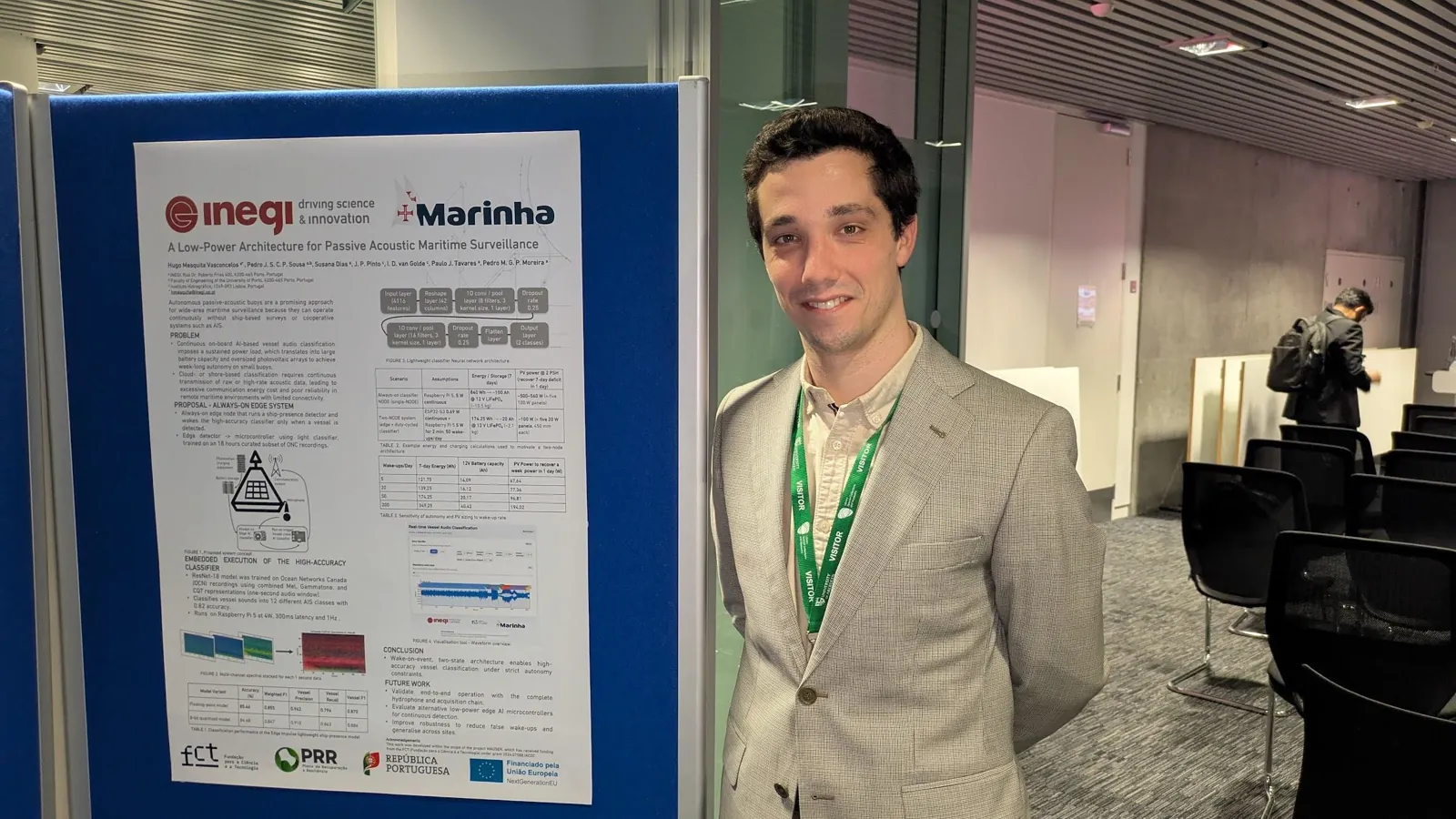
Portugal has one of the largest sea areas in Europe to watch. Buoys that listen for ships with a hydrophone are discreet and cheap,
but running a classifier non-stop drains the battery. The question was how to keep a buoy listening for months on a small battery and solar panel.
What I did
I was the main person responsible for the technical development from the start of the project, with support from my supervisor.
Developed the AI models that detect a ship and classify the type of vessel from its sound.
Worked out the two-stage architecture shown here, so the power-hungry classifier only wakes when there is something to hear.
Ran the hardware tests and on-device inference, benchmarking on Jetson AGX Orin, Raspberry Pi 5 and Raspberry Pi 3.
Built and integrated the full setup.
Battery and solar panel needed for the buoy
Classifier always on840 Wh · 467 W PV
Two-stage design174 Wh · 97 W PV
About four times smaller in both.
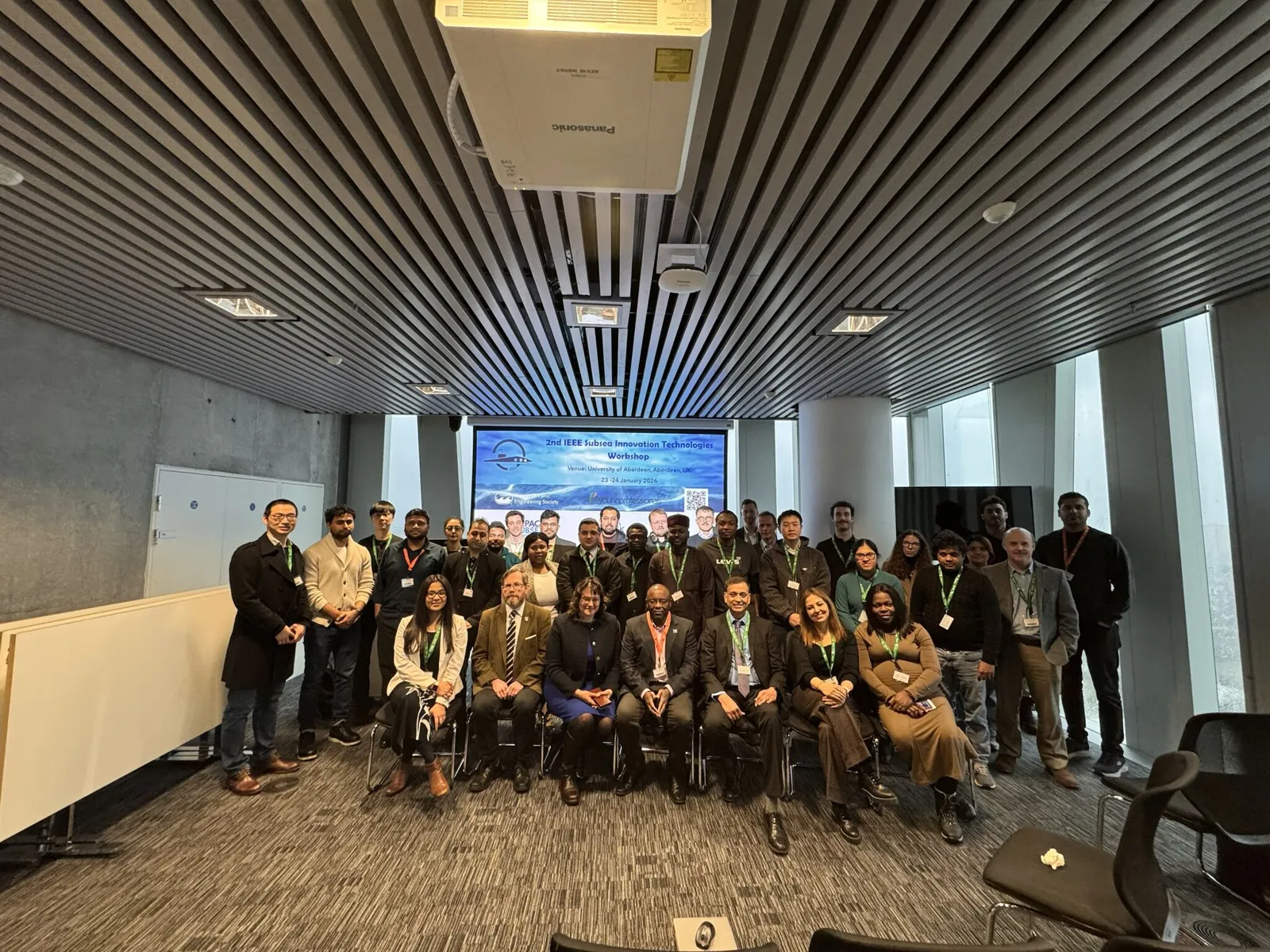
Presenting the architecture at the IEEE Subsea Innovation Technology Workshop, Aberdeen, 2026.With the workshop participants, Aberdeen.
Recovery and Resilience Plan (PRR) · with Mecânica Exata and Bairrimoldes
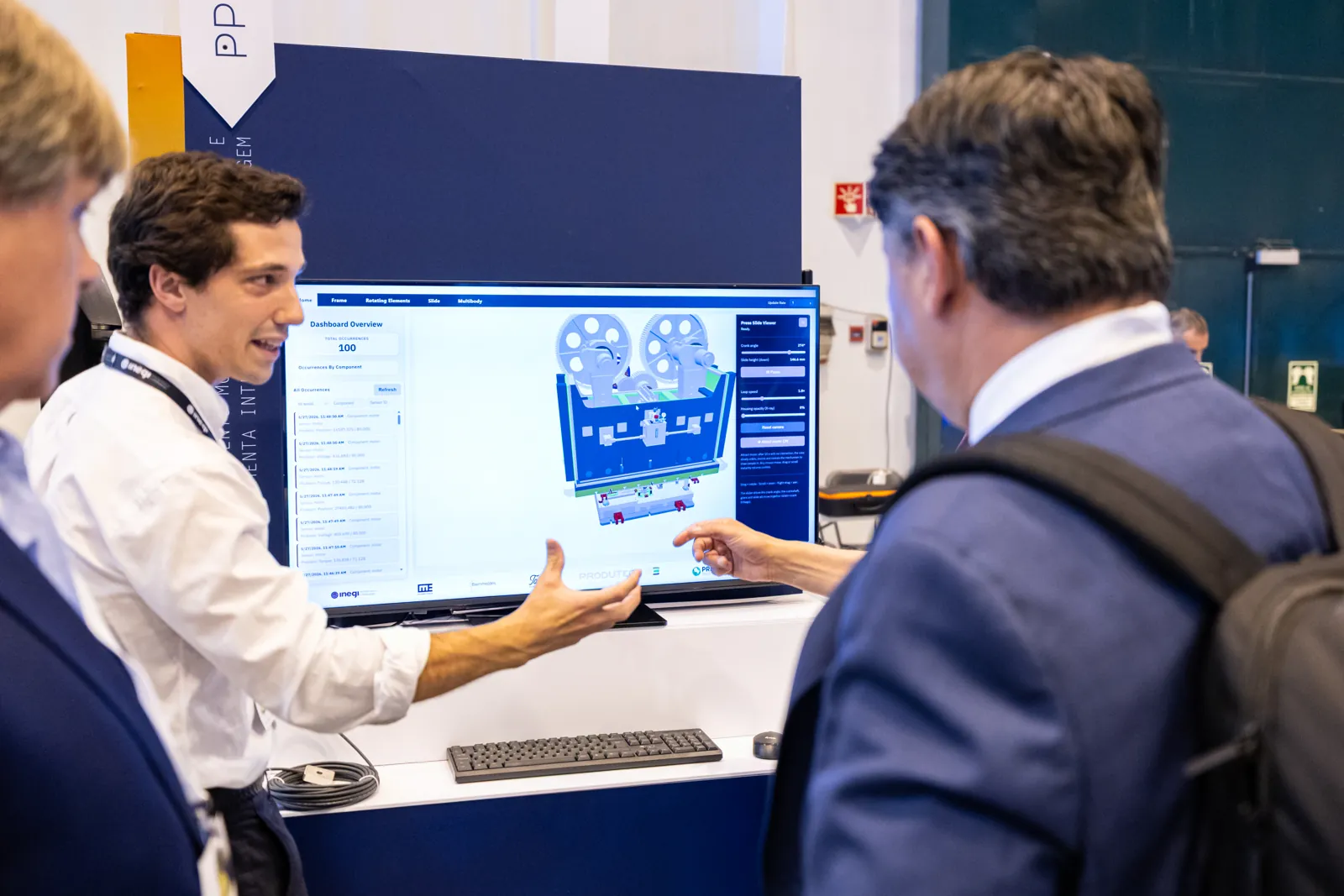
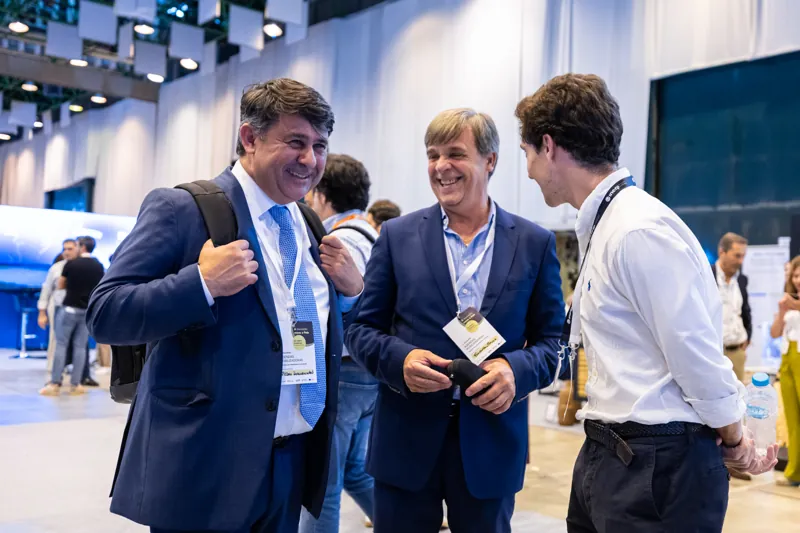
Encontro das Agendas Mobilizadoras, Aveiro, June 2026: presenting the press digital twin, with Pedro Dominguinhos, President of the PRR National Monitoring Committee, in the background.
A digital twin of a 400-tonne servo press
PRR Produtech is one of the Agendas Mobilizadoras, Portugal's large industry programmes under the Recovery and Resilience Plan. With the press maker Mecânica Exata and the
stamping company Bairrimoldes, INEGI built a digital twin of a 400 t servo press: a live model of the machine fed by its own monitoring data.
We presented the result to the president of the PRR National Monitoring Committee, Pedro Dominguinhos.
What I did
Followed and helped the development of the digital twin throughout the project.
Connected the multibody model of the press to the monitoring system, the link that makes the twin "live".
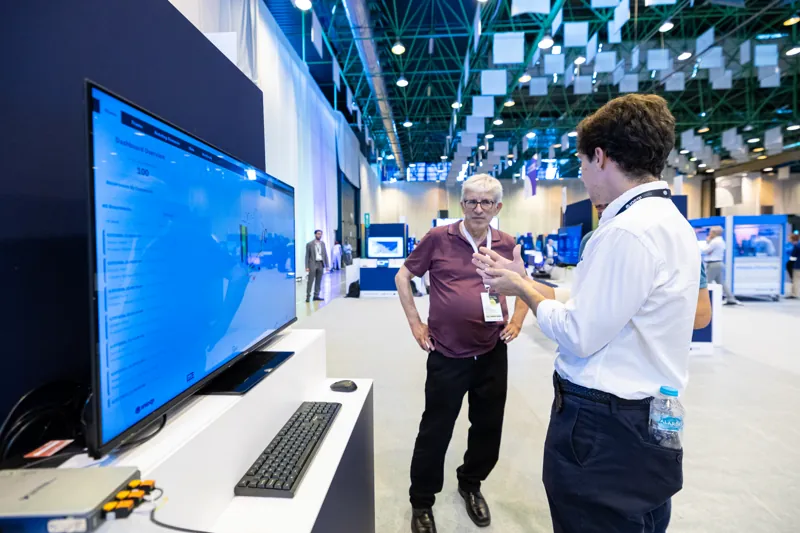
Developed the 3D visualiser that runs on the machine.
A client needed to know how much two tall towers in Germany, 80 m and 90 m, actually move. There is no power and no network at the top,
so the system had to run on batteries, unattended, continuously for five years.
Position
GNSS with a reference station at the base and a receiver at the top: centimetre-level tip displacement
Dynamics
Accelerometer at the top, plus a weather station for wind
Link
RS485 from top to base: a differential link that copes with the long cable run and the electromagnetic interference on a transmission tower
Power
Fully battery-powered, off-grid
What I did
Responsible for the system from the start, with support from my supervisor: hardware, firmware, power budget and data chain. Running since 2025.
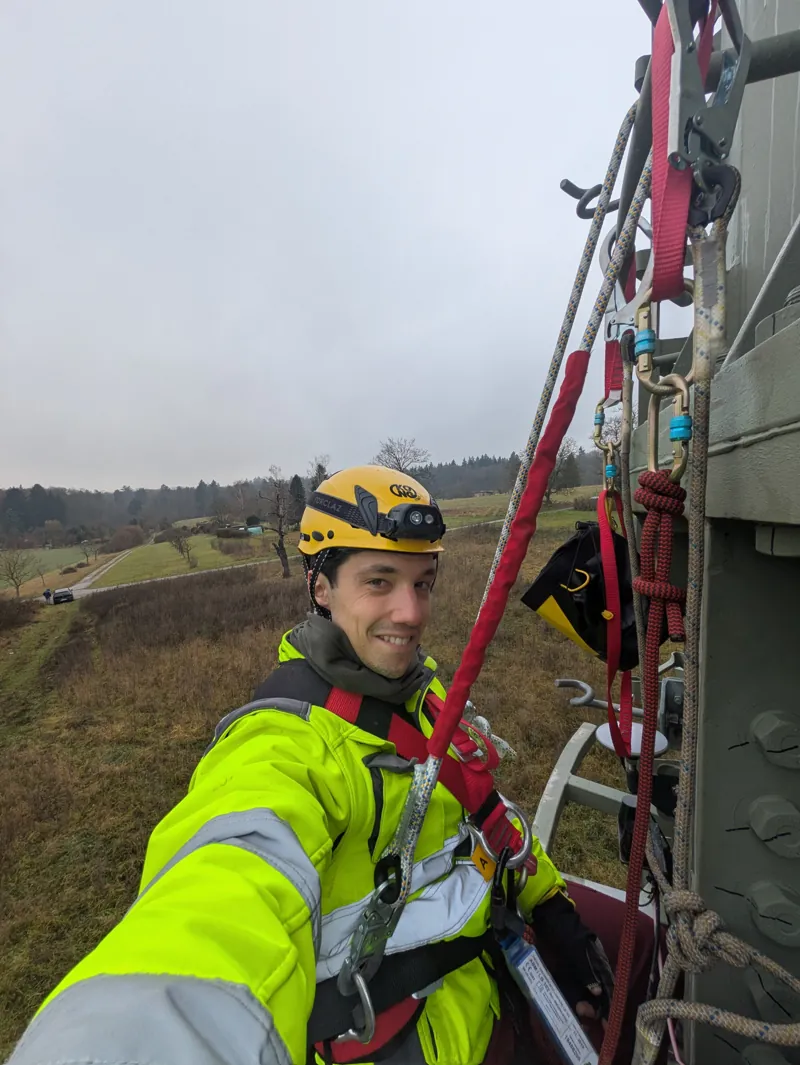
Went on site for a repair, working at height with GWO certification.
On the tower during the repair visit.
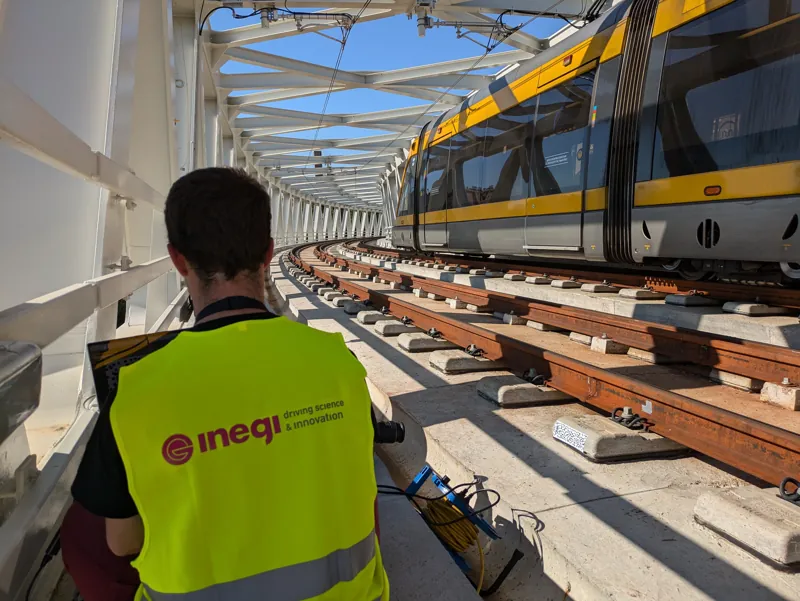
Metro do Porto
Optical measurement of how far the rail support blocks move as trains pass, validating the infrastructure's performance under real operating conditions.
Developing now
Work in progress, so there is less I can show
Confidential
Luminspect
Drone-based luminescence inspection of solar panels. The work is still under confidentiality, so the details will have to wait.
Next step after Mauser
VERNE
The continuation of Mauser: taking the low-power acoustic surveillance from the bench to a buoy on the water, with the goal of having one deployed by 2028.